
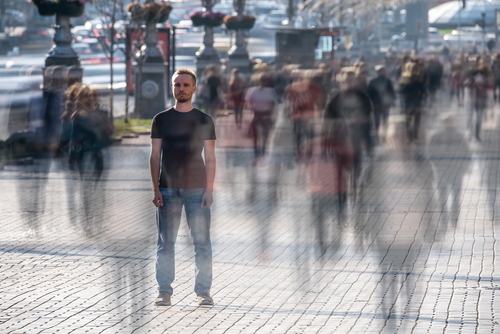
The quiet call of Christ to notice the people we often overlook.
Luke 10:36–37
“Which of these three do you think proved to be a neighbor to the man who fell into the robbers’ hands?” And he said, “The one who showed mercy toward him.” Then Jesus said to him, “Go and do the same.”
What comes to mind when you say the words, “I love…”?
For most people, several answers rush in immediately. It might be a favorite food, a place you enjoy being, or something you love to do. But more often than not, the first thing that comes to mind is a person.
We are built for relationship. When we think about love, our minds naturally move toward people—our spouse, our children, our parents, close friends, or someone who has had a meaningful influence on our lives. Loving them feels natural because the relationship is already there.
When Jesus calls us to love others, these are often the people we picture first. They are the ones we naturally feel responsible for caring about.
Now try another phrase.
“I really don’t like…”
Just as quickly, someone probably came to mind.
Just as there are people we love, there are people we struggle with. Personalities clash. Someone may have treated us unfairly or hurt someone we care about. Sometimes those wounds run deep, and resentment can linger.
Scripture addresses this instinct directly. In Matthew 5:44 Jesus says, “Love your enemies and pray for those who persecute you.” That command stretches us beyond what feels natural. Loving those who oppose us requires humility, grace, and a heart shaped by Christ.
So when we think about loving others, we often divide the world into two groups.
People we love.
People we struggle to love.
Friends and enemies.
But there is a third group we often overlook—and it is by far the largest.
Most of the people we encounter each day fall into neither category.
They are simply unnoticed.
They are the person standing ahead of us in the grocery store line. The coworker whose name we barely remember. The driver in the car beside us at a stoplight. The person sitting two rows behind us at church.
They exist in our world, but they rarely occupy our thoughts. We are not opposed to them; we simply never pause long enough to truly see them.
Years ago, I came across a social media post from someone I had gone to high school with. The post tagged several classmates. As I read through the names, I recognized most of them.
But there was one name I didn’t recognize at all.
Curious, I clicked the profile and looked at the picture. I checked mutual friends and tried to piece together who this person was. Nothing came to mind. I hadn’t forgotten them.
I realized something stranger.
I had never known they existed.
We had graduated in the same class, yet somehow our paths crossed for years without me ever noticing them. Maybe we shared a hallway. Maybe we sat near each other in a class. Perhaps we stood in the same lunch line dozens of times.
Yet I went through my entire high school experience without once acknowledging their presence.
And the sad truth is that they probably were not the only one.
That realization stuck with me because it revealed something about the way we move through life.
We pass countless people every day without truly seeing them.
Yet when we look at the life of Jesus, we see something very different.
Jesus consistently noticed people that everyone else overlooked.
A leper isolated from society.
A blind man sitting beside the road.
A woman suffering from years of illness.
Children brushed aside by busy adults.
To the crowds around Him, many of these people were interruptions or inconveniences. But to Jesus, they were individuals worthy of compassion.
He stopped for them.
He spoke with them.
He touched them.
He healed them.
He saw people others never bothered to see.
One of the clearest examples of this principle appears in the parable of the Good Samaritan. A wounded man lay on the side of the road, beaten and helpless. Several people passed by without stopping. They likely saw him—but they did not truly see him.
Only the Samaritan stopped. Only he allowed compassion to interrupt his plans.
At the end of the story Jesus asks a simple question: which person proved to be a neighbor?
The answer was obvious. The neighbor was the one who showed mercy.
The lesson was not merely about identifying who our neighbor is. It was about becoming the kind of person who notices the need in front of them.
Our challenge is often not that we refuse to love our friends or that we fail to recognize the need to love our enemies.
Our real challenge is that we simply overlook most of the people around us.
We move quickly through our days focused on schedules, responsibilities, and personal concerns. When a moment of stillness appears—standing in line, sitting in a waiting room, or waiting for an appointment—we often reach for our phones to fill the space.
We scroll, text, or check messages.
Meanwhile, the people around us remain invisible.
Yet those unnoticed individuals are not invisible to God.
Each one carries a story. Each one bears burdens we cannot see. Each one has hopes, fears, struggles, and needs. Many of them are quietly longing for encouragement, kindness, or hope.
What if loving others begins with something much simpler than we imagine?
What if it begins with noticing them?
Loving the unnoticed does not always require grand gestures. Often it starts with small acts of awareness and kindness.
Look up when you enter a room instead of looking down at your phone.
Make eye contact with someone who seems invisible to everyone else.
Offer a kind word to the person serving you at a counter or standing beside you in line.
These moments may seem small, but they are not insignificant.
Sometimes the most powerful expressions of Christlike love happen in ordinary interactions that take only a few seconds.
A simple smile.
A patient response.
A brief conversation that communicates dignity and care.
Those moments remind people that they are not invisible.
They remind them that someone sees them.
And in those moments, we quietly reflect the heart of Christ.
Friends and enemies are easy categories to recognize. But most of the people we encounter every day fall somewhere in between.
They are the strangers we pass in stores, the people who share our sidewalks, the quiet faces in waiting rooms and lines.
They may be unnoticed by us, but they are never unnoticed by God.
Perhaps loving our neighbor begins with something very simple—learning to see the people around us.
Who around you today might simply need to be noticed?
Perhaps someone in your life today could use this reminder as well.
Be First to Comment