
Word of Forgiveness and Promise
Forgiveness Spoken. Salvation Received.
Luke 23:34, 39–43
While each of the seven words from the cross carries deep significance, there is something especially captivating about the first words that fall from the lips of our Savior.
I am undone by them.
They are not words I would have spoken.
They are not words I could have spoken.
And yet—they are exactly what we should expect from Jesus.
“Father, forgive them, for they know not what they do.”
A Prayer We Would Not Pray
Consider the moment.
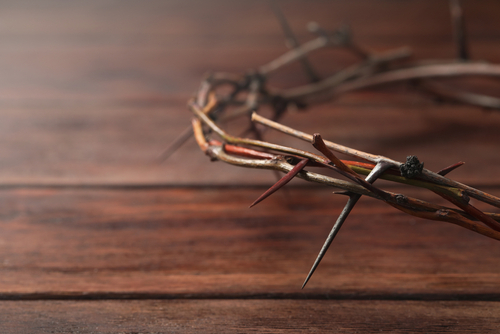
Jesus had endured hours of relentless abuse. His beard had been torn from His face. He had been struck, mocked, and spit upon. A whip had ripped open His back. Thorns had been pressed into His brow. Every step toward Golgotha carried the weight of both physical agony and mounting humiliation.
Then came the nails.
The piercing of His hands and feet.
The lifting of the cross.
The violent drop into the ground.
And still—the crowd did not relent.
They mocked Him. Ridiculed Him. Shamed Him.
No mercy. No compassion. Only hatred.
And yet—Jesus sought no vengeance.
If it were us, we would cry out for justice. We would want wrongs to be made right. We would demand that those responsible pay for what they had done.
But not Jesus.
He does not say, “Father, judge them.”
He says, “Father, forgive them.”
At the hands of sinful men, suffering in the most unjust way imaginable, He does not call for their punishment—He prays for their pardon.
And more than that—He provides it.
He is not merely asking God to overlook their sin. He is stepping in to bear it Himself.
And we must be careful not to distance ourselves from that scene.
It is easy to read this account and think only of them—those soldiers, those religious leaders, that angry crowd.
But Scripture presses us to see something deeper.
We were not merely observers—we were participants.
Our sin.
Our rebellion.
Our transgressions.
They are what placed Him on that cross.
And yet—He did not call for our destruction, though we deserve it.
He did not call for our punishment, though it was earned.
He called for our forgiveness…
…and then paid the price to secure it.
A Response That Reveals the Heart
As those words of forgiveness hang in the air, our attention is drawn to the scene unfolding beside Him.
Two men.
Two crosses.
Two responses.
This is a familiar story—not just because we’ve heard it before, but because we recognize it.
Both men are guilty.
Both are suffering the consequences of their sin.
Both are facing death.
Both are moments away from eternity.
They are equally close to Jesus—yet worlds apart in how they respond to Him.
At first, both join in the mockery. Both hurl insults. Both reject Him.
But then something changes.
One continues down that same path:
“If You are the Christ, save Yourself—and us!”
He sees Jesus—but only through the lens of his own desires. He wants relief, not redemption. Escape, not transformation. He is close to Jesus physically, but far from Him spiritually.
He sees—and still turns away.
But the other man begins to see clearly.
“Do you not fear God, since you are under the same sentence of condemnation? And we indeed justly… but this Man has done nothing wrong.”
In that moment, everything shifts.
He recognizes his guilt.
He acknowledges his sin.
He confesses Jesus’ innocence.
And with nothing to offer, no ability to make amends, no opportunity to clean up his life—he simply turns to Jesus and says:
“Jesus, remember me when You come into Your kingdom.”
No long speech.
No religious performance.
No list of promises.
Just a sinner—aware, honest, and desperate.
And then he hears the words that change everything:
“Truly I say to you, today you will be with Me in paradise.”
Forgiveness Made Personal
Do you see what is happening?
The forgiveness Jesus prayed for…
is now being received.
The first word from the cross declares that forgiveness is available.
The second word shows how that forgiveness becomes personal.
One criminal rejects it.
The other receives it.
Both were near Jesus.
Both heard His words.
Both witnessed His suffering.
But only one believed.
Proximity to Jesus is not the same as faith in Jesus.
Being near the things of God is not the same as trusting in the Son of God.
One man dies hardened in his sin.
The other dies resting in grace.
The Gospel on Display
In just a few short hours, three realities unfold before us:
Jesus, the sinless One, dies bearing the sins of others—even the man hanging beside Him.
One criminal dies in his sin—facing the full weight of God’s wrath.
The other dies forgiven—because Another bears that wrath in his place.
That is the gospel—clear and unmistakable.
The weight that should have crushed us…
was placed on Him.
The judgment that should have fallen on us…
fell on Christ.
And the forgiveness He prayed for…
is now offered freely to all who will receive it.
Your Place in the Story
This is not just their story.
It is ours.
We all stand in the same position—guilty, unable to save ourselves, and facing eternity.
The evidence of our lives is stacked against us. No amount of effort, morality, or intention can undo what sin has done.
But there is One who is different.
Blameless.
Sinless.
Righteous in every way.
And He is willing to take what we deserve.
Even now, the same choice remains.
Turn toward Him…
or turn away.
There is no middle ground.
You are not a third person in the story.
You are one of the two.
The Question That Remains
At the cross, Jesus shows us both sides of salvation:
A Savior who speaks forgiveness—
and a Savior who gives life.
“Father, forgive them…”
“Today you will be with Me…”
Forgiveness has been spoken.
The question is not whether it is available.
The question is—
will it be received?
You’re right if course, it’s such a familiar story. But I see the two men on the crosses beside Jesus in a different light now. We are all like them … with a choice to make.